Gateway Stages
The Gateway curriculum includes four stages: Cornerstone, Gateway, Keystone, and Capstone. Each of these four stages offer distinct course labels, specific to each stage. More information on each stage can be found below.
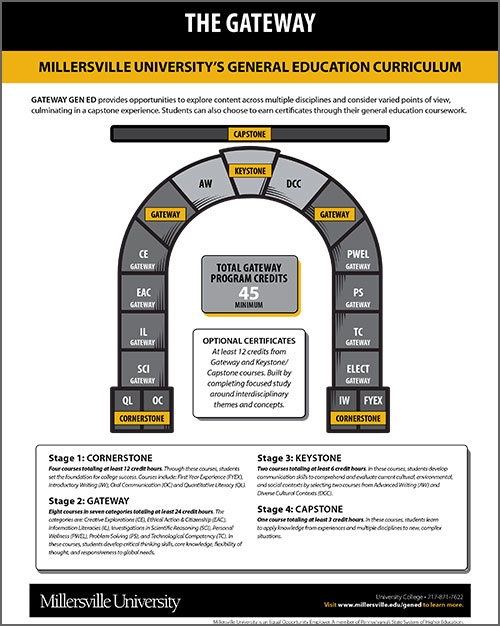 Gateway General Education (PDF) at Millersville supports students in their transition to the university experience and promotes a personalized pathway to academic success. The program provides opportunities to explore content across multiple disciplines and consider varied points of view, culminating in a capstone experience. Students can also choose to earn certificates through their general education coursework.
The Gateway program supports the development of the following program learning outcomes to extend the depth of study accomplished in the major programs:
Following a specific set of guidelines, advisors and students will work together to plan a course of study appropriate for the student's major(s) and minor(s).
Gateway Advising WorkSheet Faculty and Staff Resources (Requires login)
The Gateway curriculum includes four stages: Cornerstone, Gateway, Keystone, and Capstone. Each of these four stages offer distinct course labels, specific to each stage. More information on each stage can be found below.
Students can also choose to earn optional certificates through their general education coursework to build thematic learning experiences by completing focused study around interdisciplinary themes, concepts, and settings.
Definition: Quantitative Literacy courses utilize mathematics and/or statistics to formulate and/or solve equations and interpret numerical data. These courses incorporate critical thinking and problem-solving skills to help students develop an understanding of numbers to build a foundation for understanding mathematics and statistics in real-world contexts and solving more complex mathematics problems.
Students will be able to:
Definition: First-Year Seminar (FYEX) courses are designed to support students’ successful transition to university life. These courses use at least one high-impact educational practices to develop and foster skills that will lead to success in college, career, and personal life. Each seminar focuses on a different topic/theme of strong interest to faculty and students.
Students will be able to:
Definition: Oral communication courses focus on prepared, purposeful speaking designed to do one or more of the following, to increase knowledge, to foster understanding, to entertain and comfort audience members, to promote change in the listeners’ attitudes, values, beliefs, or behaviors.
Students will be able to:
Definition: Introductory Writing courses facilitate the development of college-level proficiency in the use of writing processes, critical awareness when reading and writing, stylistic fluency, and technical accuracy.
Students will be able to:
Definition: Investigations in Scientific Reasoning courses primarily focus on an empirical study of the natural world while providing training in the tools, processes, and subject matter appropriate to the discipline to address theoretical and/or practical issues. These courses emphasize that the scientific meaning of fact, theory, and law are not a hierarchy, and give students an appreciation of essential creative aspects of scientific process and discovery. Students must spend at least two contact hours per week (preferable consecutive) in hands-on (in person or approved online) lab, because of the applied nature of science labs.
Students will be able to:
Definition: Information literacy is a set of integrated abilities requiring students to recognize when and what information is needed and to locate, evaluate, and effectively use the needed information to participate ethically in communities of learning and/or practice. Students proficient in information literacy critically reflect on the economic, legal, and social issues surrounding the creation, access, and use of information. As a result, students will be able to incorporate new understandings into their perspectives, questions, or works (academic, professional, or creative).
Students will be able to:
Definition: Personal Wellness encompasses multiple dimensions that are interconnected to promote optimal health and well-being. Students will select a course that focuses on one or more of the following: emotional, environmental, financial, physical, social, spiritual, or occupational. These courses emphasize the personal choices and responsible actions that lead to success.
Students will be able to:
Definition: Creative Explorations courses focus on creating, combining and/or synthesizing ideas, images, or expertise in original ways. In these courses, students think, respond, communicate, and work in imaginative ways, characterized by innovation, divergent thinking, and risk-taking.
Students will be able to:
Definition: Problem Solving courses involve designing, evaluating, and implementing strategies to answer questions or achieve stated goals using foundational critical thinking and/or logical problem-solving skills and processes. Students will research and evaluate evidence, collect, and analyze information, formulate conclusions, and communicate results effectively.
Students will be able to:
Definition: Courses in Ethical Action and Citizenship apply ethical principles to investigate real-world issues in cultural, economic, environmental, historical, political, and/or social contexts. Students in these courses will identify and communicate about challenges on local, national, and/or global levels in civically responsible ways.
Students will be able to:
Definition: Technological Competency courses address the ability to identify, assess, manage, adapt, and use tools, applications, and systems to effectively and responsibly accomplish tasks.
Students will be able to:
Definition: Keystone courses—Diverse Cultural Contexts and Advanced Writing— support students as they extend Gateway stage exploration and skill-building into engagement with the cultural, environmental, economic, political, and social contexts of today’s global issues. It is recommended that these courses are linked to create learning communities and taken after the completion of the Gateway stage courses or completion of 54 credits. The two Keystone courses must be at the 300 level or above and total at least six credit hours.
Definition: Diverse Cultural Contexts courses promote student exploration and analysis of cultural, environmental, economic, political, and social contexts in the world today. Students will engage in conversation to examine issues, proactively seek to understand multiple perspectives, and consider possible outcomes. DCC courses also provide extended practice with oral communication in modalities appropriate to the course.
Students will be able to:
Definition: Advanced Writing courses extend students’ writing processes and rhetorical awareness to align with writing domains and situations that students might encounter in their professional lives. Students will learn to write to professional and public audiences, compose in a variety of genres, and adapt their writing style based on the needs of typical rhetorical situations.
Students will be able to:
Definition: The Capstone is the culminating experience where students apply knowledge from across the stages of the General Education Program to their discipline(s) to explore a big idea, issue of practice, or complex problem. Students will gain a broader understanding of the idea, issue, and/or problem and its context, making connections between their learning and their personal experiences, to demonstrate their understanding.
The Capstone is one course at the 300-level or above with 3 to 4.5 credit hours. Departmental (major) capstones, including student teaching, practicums, internships, co-op experiences, exhibitions, Honors and departmental theses, portfolio courses, and the like may also serve as General Education Capstones if they meet the defined student learning outcomes.
Students will be able to:
Gateway Program Certificates are intended to include courses and experiences that address real-world issues by utilizing integration, synthesis, and innovative thinking from multiple perspectives and fields of study. Students can use these optional curricular pathways to build thematic learning experiences by completing focused study around interdisciplinary themes, concepts, and settings.
Definition: Gateway Program Certificates are optional curricular pathways designed by at least three academic departments that include a selection of interrelated courses from the Gateway stage plus a designated final course: a 3-credit Keystone (DCC or AW) or Capstone course. Certificates will total 12 to 17 credits (18 credits would be considered a minor).
Students may earn a maximum of two certificates within the context of their Gateway Program. Students may use the same courses to satisfy both Gateway Program requirements and Gateway Program Certificate requirements.
Students may also use the Capstone course of their major program as the Capstone course for a Gateway Program Certificate if that course is an approved General Education course.
Students will be able to: