Department of Environment, Geosciences & Emergency Management
Millersville Meteorology Celebrates 30 Years of Research
students conduct severe weather research in the great plains
Millersville Meteorology has a strong and consistent record of providing undergraduate students with research opportunities that have spanned from field research to information technology research to the development of alternative learning systems. Students are able to work with faculty members on both externally funded research projects in addition to individual projects.
Students also have the opportunity to build their own research project. One recent example is the Thermodynamic Investigation of LCL Thresholds at Tornadogenesis and its Influence in the Northeast and Great Plains (TILTTING) project, which was proposed and carried out completely by students under the supervision of Dr. Greg Blumberg and Mr. Kyle Elliott. For details on the project and how to support the students, visit TILTTING-BL (project-blasted.github.io/). Nearly 20 students are currently involved in the project.
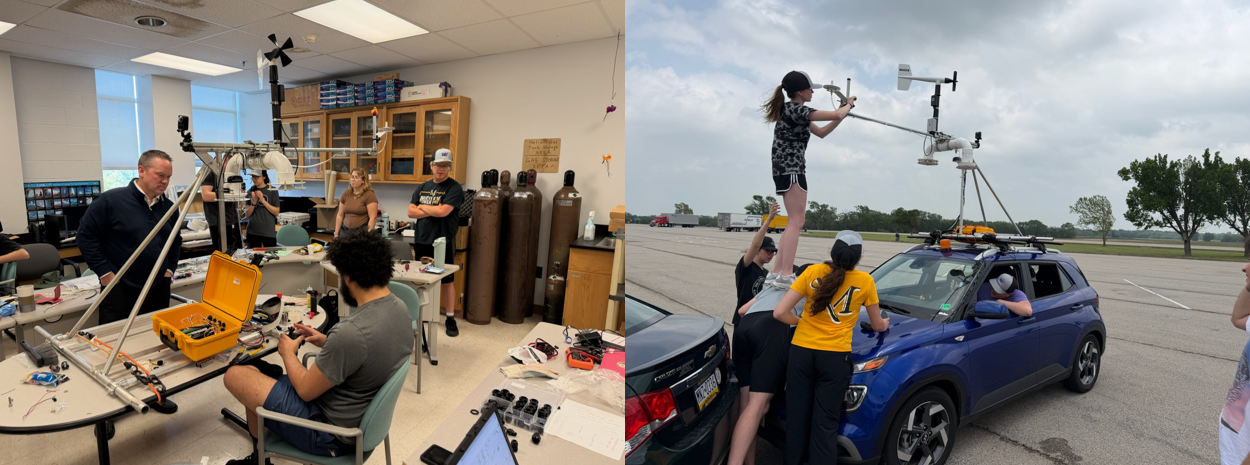
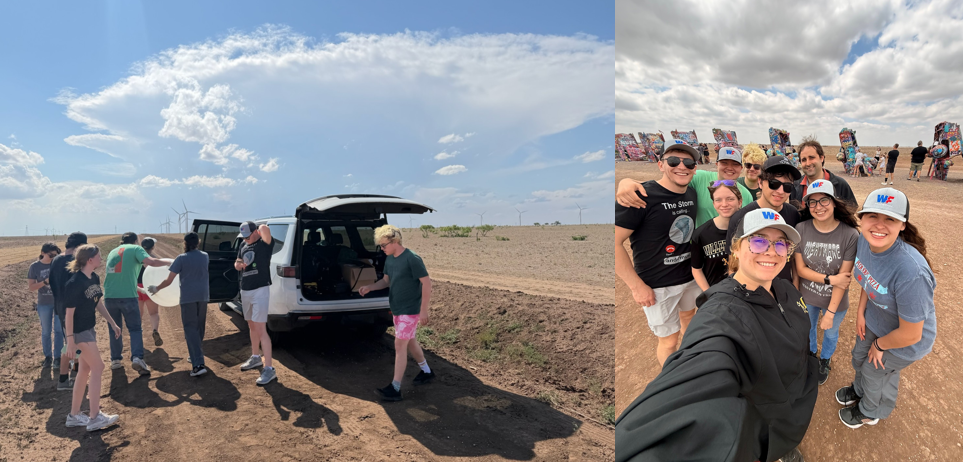
Recently, a group of 13 students formed a spin-off project (pun intended) called TILTTING-Boundary Layer (TILTTING-BL), which focuses on the day-to-night transition of the boundary layer near thunderstorms. A field deployment took place from May 17-31, 2026, in the Great Plains. The team successfully completed five Intensive Observation Periods (IOPs) in Colorado, Kansas, Oklahoma, and Texas. During each IOP, the team collected both surface and upper air data, utilizing their freshly constructed Mobile Mesonet (a mobile meteorological observation platform) and weather balloons. Incorporation of this data into numerical weather prediction models will increase accuracy of severe weather forecasts, improve tornado warning lead times and, most importantly, save lives.
Millersville alumni, faculty, and students attend 106th ams conference
This year marked the 40th straight year that students in the Millersville Meteorology program had an opportunity to attend the Annual Meeting of the American Meteorological Society (AMS). The 106th Annual Meeting of the AMS took place in Houston, TX, from January 24-29, 2026. In addition to attending all other conference sessions and special symposia during the week, students had the opportunity to take part in the AMS Student Conference. Niko Omiridis, Melanie Jones, and Rebecca Butterfield presented their research as part of the student research poster session.
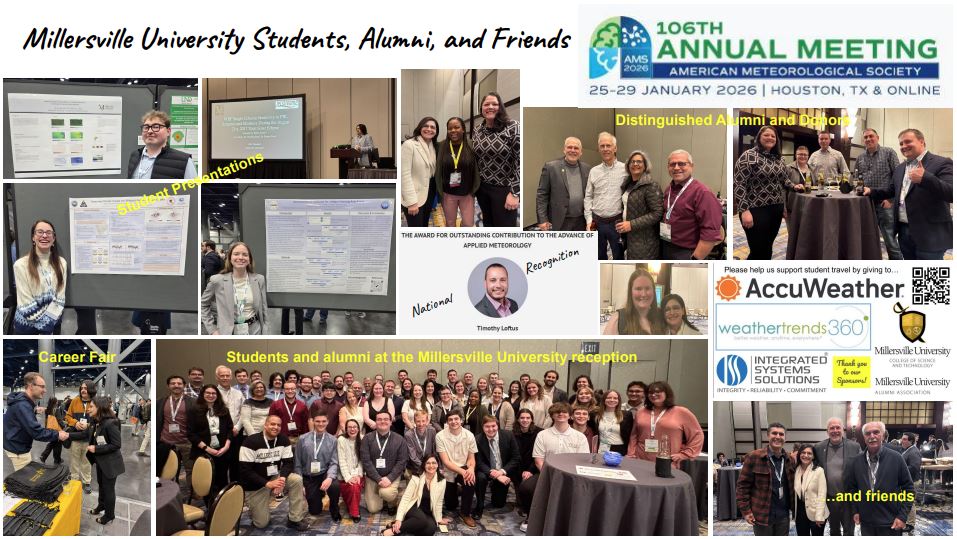
Additionally, Millersville University meteorology and emergency management programs hosted the MU Alumni and Friends reception on January 27th where over 200 students, alumni, and friends of the programs attended the celebration. Dr. Richard Clark (Professor of Meteorology, Emeritus and Past President of the AMS) and Dr. Sepi Yalda (Professor of Meteorology, CDRE Director) served as co-organizers for the event. The event was sponsored by generous donations from Integrated Systems Solutions, WeatherTrends, AccuWeather, Millersville University's Alumni Association, and the MU College of Science and Technology.
space weather activities
Millersville Meteorology remains quite active in the Space Weather (SW) Community. We are the only program in the U.S. to offer a Graduate Certificate in Space Weather and Environment: Science, Policy, and Communication that attracts professionals from a wide range of careers. Our graduates work in fields from solar physics research to space weather forecasting and occupy leadership positions across public, private, and academic sectors. A group of MU SW current students, graduates, instructors, and program coordinators (current and emeritus) attended the 2026 Space Weather Workshop in Boulder, CO (April 27-May 1, 2026).
Drs. Sepi Yalda and Rich Clark developed and co-chaired a panel presentation and discussion along with Dr. Mike Wiltberger (National Center for Atmospheric Research (NCAR)) on Building the Space Weather Workforce of the Future on May 1. The session featured Dr. Dan Welling (University of Michigan), Dr. Robert Steenburgh (NOAA, Space Weather Prediction Center), Dr. Barbara Thompson (NASA GSFC), Marissa Vara (NCAR), and Dr. Tamitha Skov (Space Weather Woman and Faculty Associate in Space Weather at Millersville University). The session also featured poster lightning talks where current student in the MU SWEN Certificate Program, Tanya Melnik, presented a talk titled "Bridging Space Weather Operations and Local News."
In addition, MU SWEN current students, Tanya Melnik, MaryBeth Kiczenski, and Vincent Ledvina along with other co-authors presented a poster titled "Initial Survey Results on Aurora Chasers' Use of Space Weather Forecasts and Uncertainty Information." Another poster titled "Bridging Space Weather Operations and Local News" was presented by Tanya Melnik and Vincent Ledvina. Two MU graduates, Mike Cook and Tony Williams were co-authors on these posters. A third poster was presented by current MU SWEN students, MaryBeth Kicsenski and Tanya Melnik, along with their co-author titled "From the Sun to Social Media: How Aurora Chasers Use Space Weather Data."
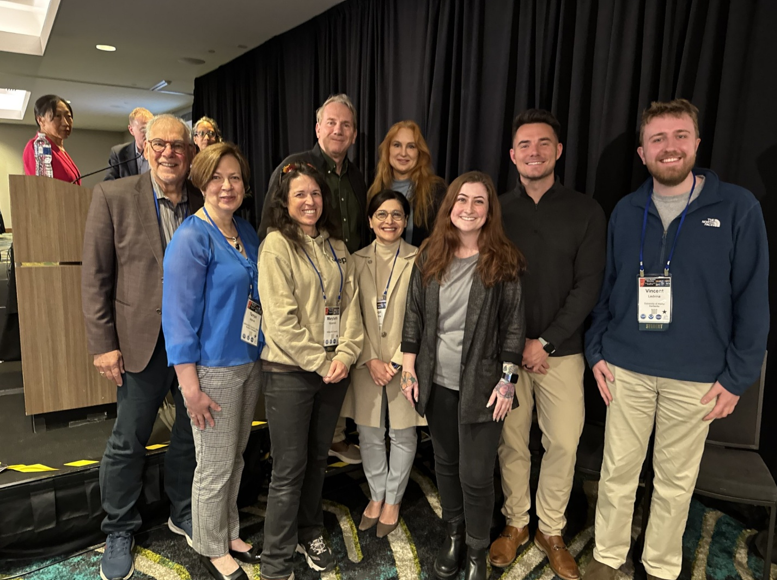 From Left to Right: Dr. Rich Clark (MU Meteorology Emeritus Professor), Tanya Melnik (MU SWEN current student), Bill Murtagh (Retired-NOAA Space Weather Prediction Center), MaryBeth Kicsenski (MU SWEN current student), Dr. Tamitha Skov (Faculty Associate-MU SWEN Program), Dr. Sepi Yalda (Professor of Meteorology and SWEN Coordinator), Sarah Housseal (MU Meteorology Alumna), Mike Cook (MU Meteorology Alumnus), and Vince Ledvina (MU SWEN current student)
VALIDATION OF SODAR/RASS MEASUREMENTS WITH RAWINDSONDE RETRIEVALS
From 2018-2023, Millersville faculty and students conducted a series of rawinsonde launches over the course of 2-3 days for the purpose of validating the wind and virtual temperatures measurements obtained by the Allegheny County Health Department (ACHD) using a Scintec Acoustic SODAR system with a RASS extension. Typically, three meteorology students from Millersville University assisted the ACHD with a research initiative involving Sound Detection and Ranging (SODAR) observations and Radio Acoustic Sounding System (RASS) retrievals with rawinsonde measurements in Clairton, Pennsylvania. Under the direction of faculty members Drs. Greg Blumberg and Richard Clark, as well as Weather Center Director Kyle Elliott, the students launched weather balloons to validate the on-site SODAR measurement - a requirement of the EPA. A radiosonde, or instrument used to transmit pressure, temperature, and relative humidity measurements at various levels of the atmosphere, was attached to each balloon. When a radiosonde is tracked so that wind speed and direction measurements are also provided, it is called a rawinsonde observation. The data was used to better understand the changes in the diurnal transition of the planetary boundary layer in the Monongahela Valley and its impact on the transport of pollutants.
recent student projects
2025-2026
Josh Contrucci: Radar Studies Utilizing the MU Climavision Radar
Becky Butterfield: Tropical Cyclone Flooding in Appalachia
Austin Carroll: Tropical Cyclone Teleconnections
Tim August: Baroclinic and Barotropic Atmospheric Models Study
Niko Omiridis: Tropical Cyclone Air-Sea Interaction
Austin Stankus: Tropical Cyclones and Tornadogenesis
2024-2025
Mark Battle: NEXRAD Radar Gaps and Impacts on Meteorology and Emergency Management Communities
Alex Sullivan: The Utility of X-Band Radars in the Refinements of QPEs
Eliza Fries: A study of ENSO and Potential Impacts on the South Dakota Fire Weather Season
2023-2024
Ryan Argenti, Rhiannon Cahoe, Gabe Keller, Gabe Pena, Anthony Haberman, Grace Dauch, Jacob Biondo: Thermodynamic Investigation of LCL Thresholds at Tornadogenesis and its Influence in the Northeast and Great Plains (TILTTING)
Josh Kinsky: A Climatological Survey of NE Winter Storms
Alex Massa: Pollution in Western and Southern Africa
Victoria McPeek: A Study of Atlantic Multidecadal Oscillation and Potential Impacts on Tropical Storm Activity
Hannah Warner: A Study of Hazardous Weather Messaging
Alison Krantz: Tornado Generated Fire Vortices
Keelie Steiner: Study of Aerosols and Atmospheric Chemistry