Undergraduate Student Research
Where Curiosity Takes Flight - Classroom Learning to Real-World Discovery
The Department of Environment, Geosciences, and Emergency Management prides itself on encouraging high-quality, hands-on research experiences. Students apply classroom knowledge to real-world challenges and open scientific questions developing the technical, analytical, and professional skills that employers and graudate programs value. These curiosity-driven research experiences help students refine their craft, build conficence in their abilities, and gain experiences needed to excel academically and professionally.
Karst Hazards in Central Pennsylvania - A geologic and emergency management perspective.
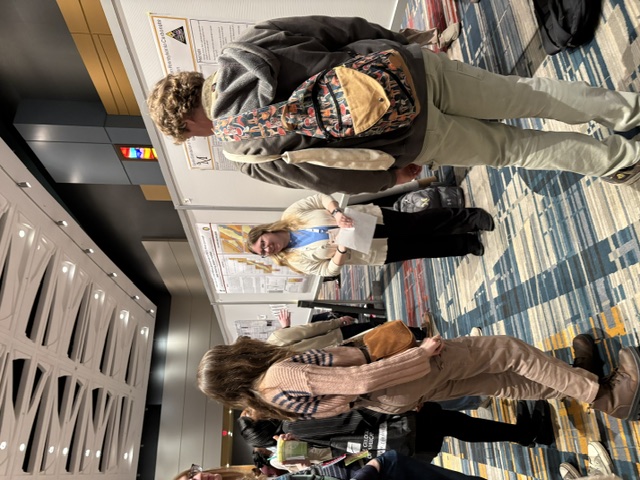
Jessica Cabibbo, a dual geology and emergency management major, completed her senior thesis entitled, "Spatial Distribution of Karst Features in Carbonate Formations of South‑Central and Southeastern Pennsylvania and Implications for Hazard Mitigation." Jessica used her knowledge of karst geology and gis to identify geologic formations with a high density of karst features. She then used this information to suggest prevention, mitigation, and preparedness for both rural and urban communities. Jessica presented this research at both Made in Millersville and the Geological Society of America's Northeast Regional Meeting in Hartford.
project tiltting students Storm chase in the great plains
Following their encounter with the EF-3 tornado in Mullica Hill, N.J., during Hurricane Ida, Millersville meteorology students launched the TILTTING (Thermodynamic Investigation of LCL Thresholds at Tornadogenesis) project under the leadership of Weather Information Center Director Kyle Elliott. More than 25 students have participated and continue to participate in the project. More than a dozen students have spent two weeks in the Great Plains in either May 2024 or June 2026 conducting tornado research with Dr. Greg Blumberg. The teams released weather balloons near supercells to measure atmospheric conditions and better understand storm environments. Students also visited the Storm Prediction Center and National Weather Center in Norman, Okla., where they met with forecasters and toured research facilities. Data collected during the multiple Intensive Observation Periods were shared with the SPC and local National Weather Service offices. Learn more or support the project at millersville.edu/tiltting.
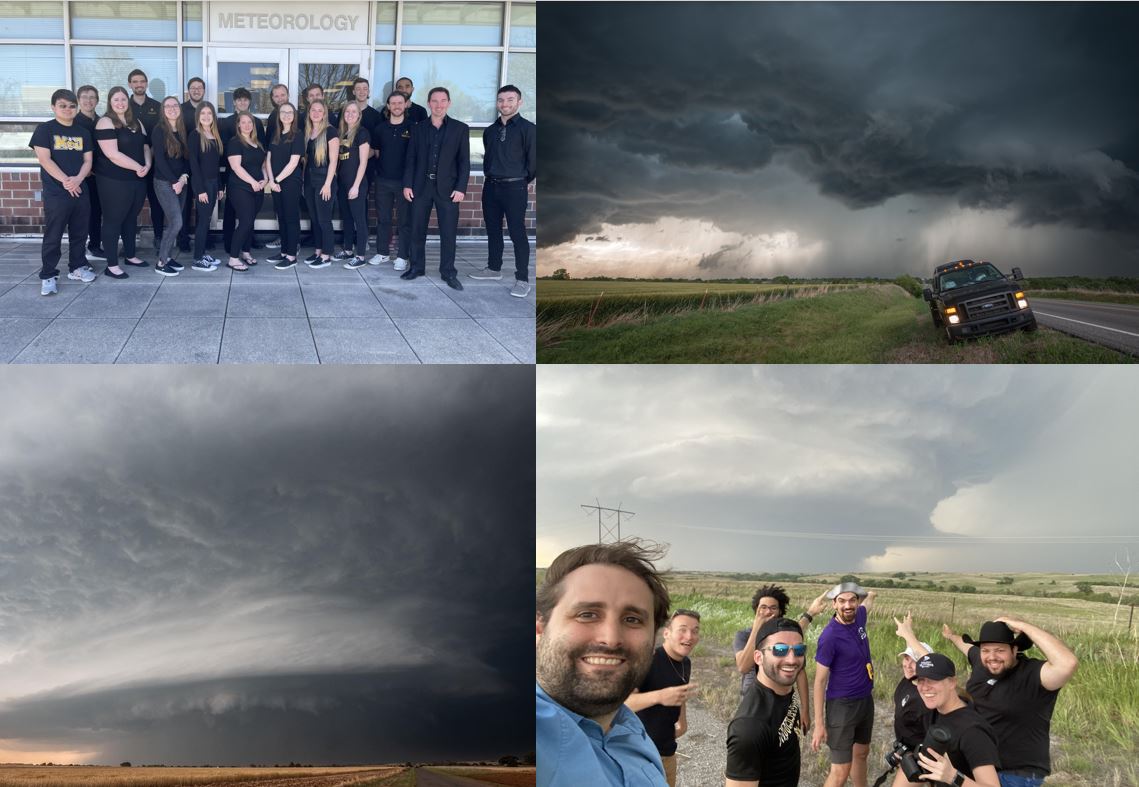
The students have also designed their own probes that will eventually be used to penetrate and measure wind velocity and pressure perturbations within the condensation funnel of a tornado. IOPs have and will continue to be conducted in the Northeast, with teams of 6-10 students deploying on a rotating basis. Three IOPs took place in the Northeast during Summer 2022, with another three happening during Summer 2023. Incorporation of this data into numerical weather prediction models will increase accuracy of severe weather forecasts, improve tornado warning lead times and, most importantly, save lives.
VALIDATION OF SODAR/RASS MEASUREMENTS WITH RAWINDSONDE RETRIEVALS
From 2018-2023, Millersville faculty and students conducted a series of rawinsonde launches over the course of 2-3 days for the purpose of validating the wind and virtual temperatures measurements obtained by the Allegheny County Health Department (ACHD) using a Scintec Acoustic SODAR system with a RASS extension. Typically, three meteorology students from Millersville University assisted the ACHD with a research initiative involving Sound Detection and Ranging (SODAR) observations and Radio Acoustic Sounding System (RASS) retrievals with rawinsonde measurements in Clairton, Pennsylvania. Under the direction of faculty members Drs. Greg Blumberg and Richard Clark, as well as Weather Center Director Kyle Elliott, the students launched weather balloons to validate the on-site SODAR measurement - a requirement of the EPA. A radiosonde, or instrument used to transmit pressure, temperature, and relative humidity measurements at various levels of the atmosphere, was attached to each balloon. When a radiosonde is tracked so that wind speed and direction measurements are also provided, it is called a rawinsonde observation. The data was used to better understand the changes in the diurnal transition of the planetary boundary layer in the Monongahela Valley and its impact on the transport of pollutants.
EEOS STUDENTS PRESENT AT OCEAN SCIENCES MEETING
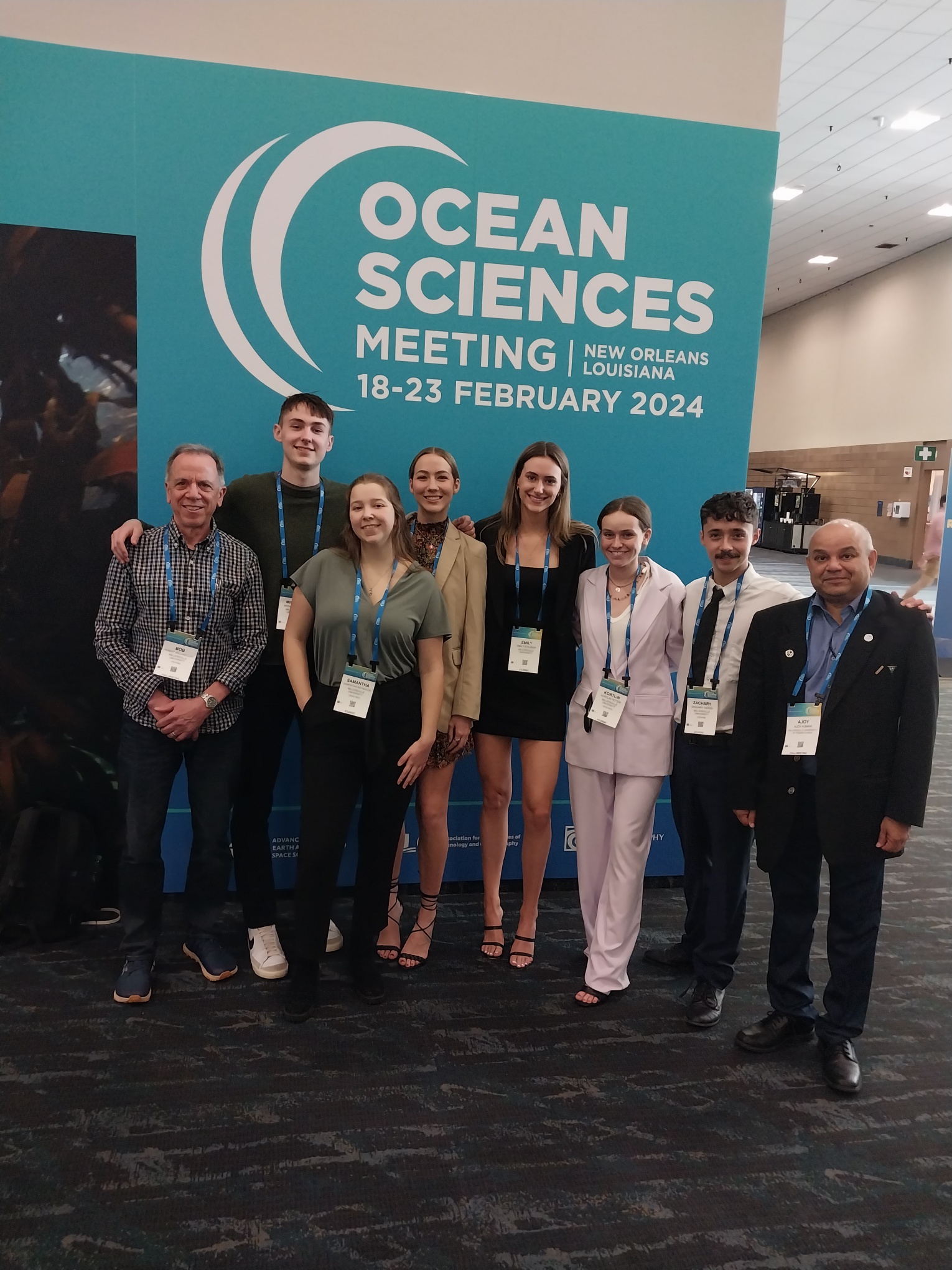
Oceanography students Mike Miller, Samantha Reynolds, Somer Barrett, Emily Stauder, Kortlin Yetter, and Zach Hersch (from left to right) presented their research at the Ocean Sciences Meeting 2024 in New Orleans in February. Their research focused on multiple aspects of oceanography from physical oceanography, remote sensing, and marine policy. Professors Robert Vaillancourt (left) and Ajoy Kumar (right) accompanied them.